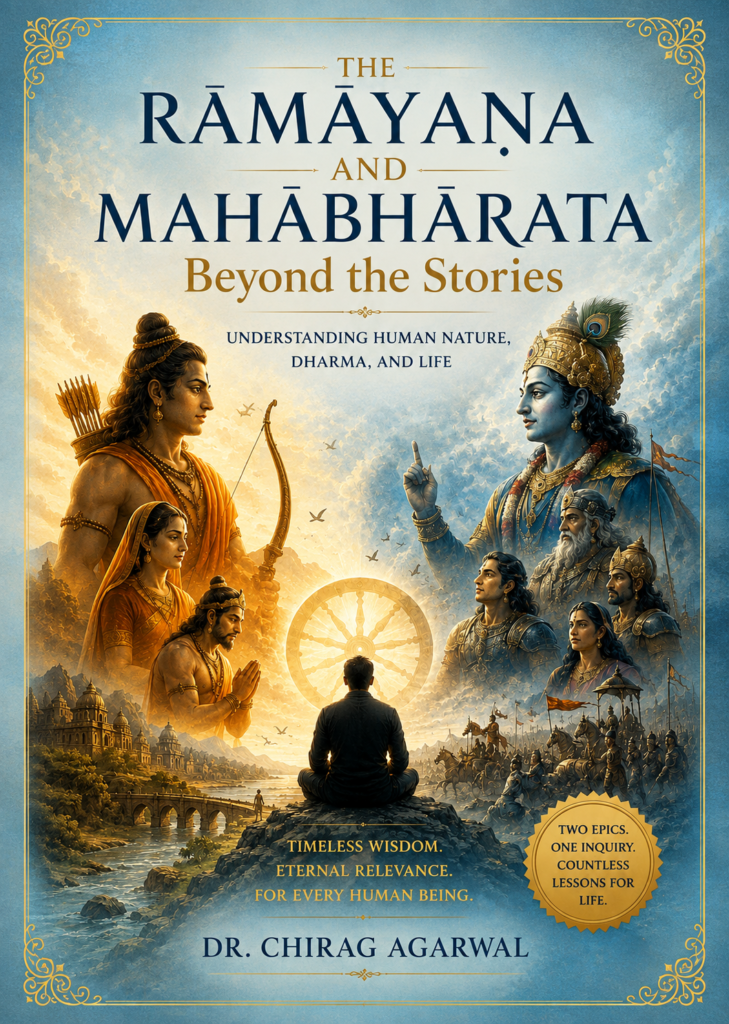
THE RĀMĀYAṆA AND MAHĀBHĀRATA : Beyond the Stories
Understanding Human Nature, Dharma, and Life
By Dr. Chirag Agarwal
Why Do the Itihāsas Still Matter?
The Rāmāyaṇa and the Mahābhārata have shaped the thought, culture, and values of Bhārata for thousands of years. Yet today, many encounter them mainly through television, films, social media, or simplified retellings.
The Rāmāyaṇa and Mahābhārata: Beyond the Stories looks beyond the familiar narratives to rediscover the deeper wisdom within them. Rather than simply asking what happened, this book asks why it happened, what the choices of its characters reveal about human nature, and what those lessons mean for us today.
The two Itihāsas are studied together, allowing their characters, choices, conflicts, and consequences to illuminate one another. Through Rāma, Sītā, Bharata, Hanumān, Kṛṣṇa, Arjuna, Bhīṣma, Vidura, Karṇa, Draupadī, and many others, the book explores questions that remain deeply relevant to modern life: How should we make difficult decisions? What happens when Dharma is not obvious? How do ego, desire, anger, and attachment influence our choices? What makes a great leader? How should we understand responsibility, relationships, truth, courage, and self-control?
This is not a book that asks you merely to admire ancient heroes. It invites you to recognise their struggles within your own life and to approach the Itihāsas as living sources of reflection, discernment, and wisdom.
Who Is This Book For?
- Anyone who wants to understand the deeper wisdom of the Rāmāyaṇa and Mahābhārata.
- Readers who want to go beyond popular retellings and explore the original narratives.
- Anyone interested in Dharma, human nature, character, relationships, and difficult choices.
- Students and seekers of Sanātana Dharma and Indian thought.
- Readers who want to connect the wisdom of the Itihāsas with modern family, professional, social, and personal life.
- Anyone who wants to understand before judging and develop greater discernment in everyday decisions.
What You’ll Explore
- Why the Itihāsas were written
- How human beings make decisions
- Why Dharma is rarely simple
- Ego, desire, attachment, anger, and self-control
- Humility, discipline, truth, courage, and resilience
- Parents, children, siblings, marriage, friendship, and loyalty
- The influence of advice and wise counsel
- Why good people sometimes make bad decisions
- How small choices shape great destinies
- The patterns behind human downfall
- Leadership and responsibility
- Justice, compassion, and power
- Dharma in difficult situations
- Peace, conflict, and the ethics of war
- Difficult questions surrounding Rāma, Sītā, Vāli, Kaikeyī, Bhīṣma, Karṇa, Kṛṣṇa, and the Kurukṣetra war
- Family life, marriage, parenting, and professional ethics
- Leadership in modern organisations
- Politics and society
- Spiritual growth beyond ritual
- What it means to become a wise human being
The book’s eight parts move deliberately from understanding human nature and building character to relationships, leadership, difficult questions, and finally applying the wisdom of the Itihāsas to contemporary life.
Book Details
- Format: Paperback
- Language: English
- Pages: 383
- Author: Dr. Chirag Agarwal
- Publisher: Sanatana Revealed
- Category: Rāmāyaṇa • Mahābhārata • Dharma • Human Nature • Wisdom
A Different Way of Reading the Itihāsas
This book is not a retelling of the Rāmāyaṇa or Mahābhārata. It brings the two Itihāsas into conversation with one another, examining similar human dilemmas through different characters and circumstances.
Most chapters begin with a universal human question, examine relevant episodes from both Itihāsas, draw upon Sanskrit sources where appropriate, and conclude with practical reflections connecting the ancient narratives to contemporary life.
The purpose is not to provide simplistic verdicts about who was right or wrong. It is to cultivate the ability to ask better questions:
What did this person know at that moment?
What responsibilities were competing?
What alternatives existed?
What consequences followed?
And what can this teach me about my own choices?
The book ultimately argues that the greatest value of the Itihāsas lies not simply in knowing their stories, but in allowing their wisdom to shape how we think, decide, and live.
Preview
Purchase
Coming Soon