
We live in an age where opinions travel faster than facts. A few seconds on social media are enough for someone to form a conclusion, defend it passionately, and dismiss every opposing view. Yet confidence is not the same as correctness.
An opinion is a personal judgment or belief. It may be informed, uninformed, reasonable, or completely mistaken. Knowledge, on the other hand, requires justification. It is built upon evidence, reasoning, and careful examination.
This distinction has always been recognized in the Indian knowledge tradition.
The Nyāya school did not encourage people to accept claims merely because they were popular or emotionally satisfying. It asked a simple but profound question: How do you know?
Knowledge (pramā) arises through valid means of knowledge (pramāṇa). Among the primary pramāṇas accepted in Nyāya are direct perception (pratyakṣa), inference (anumāna), comparison (upamāna), and reliable testimony (śabda). If a claim cannot be supported through appropriate means, it remains a belief or opinion – not knowledge.
This approach is reflected in the Bhagavad Gītā as well:
तद्विद्धि प्रणिपातेन परिप्रश्नेन सेवया ।
उपदेक्ष्यन्ति ते ज्ञानं ज्ञानिनस्तत्त्वदर्शिनः ॥
(Bhagavad Gītā 4.34)
Transliteration
tat viddhi praṇipātena paripraśnena sevayā
upadekṣyanti te jñānaṁ jñāninas tattva-darśinaḥ
“Approach those who have realized the truth with humility, sincere inquiry, and service. They will impart knowledge to you.”
Notice that the verse encourages questions, not blind acceptance. Knowledge is acquired through inquiry, not merely through agreement.
This distinction matters today more than ever.
Someone may confidently claim that a historical event happened in a certain way, that a medical treatment always works, or that an ancient practice is either miraculous or meaningless. Unless the claim is supported by reliable evidence and sound reasoning, it remains an opinion.
This does not mean opinions are worthless. Opinions are often the starting point of learning. They become valuable when we are willing to test them, refine them, or even abandon them if better evidence emerges.
The real danger is confusing certainty with knowledge. Human beings naturally become attached to their views because opinions are often tied to identity, community, or emotion. Once that happens, disagreement feels like a personal attack rather than an opportunity to learn.
A healthy society is not one in which everyone shares the same opinion. It is one in which people know the difference between an opinion and knowledge, and are willing to revise their beliefs when truth demands it.
The pursuit of knowledge begins with intellectual humility – the willingness to say, “I may be mistaken.” That is not weakness. It is the beginning of wisdom.
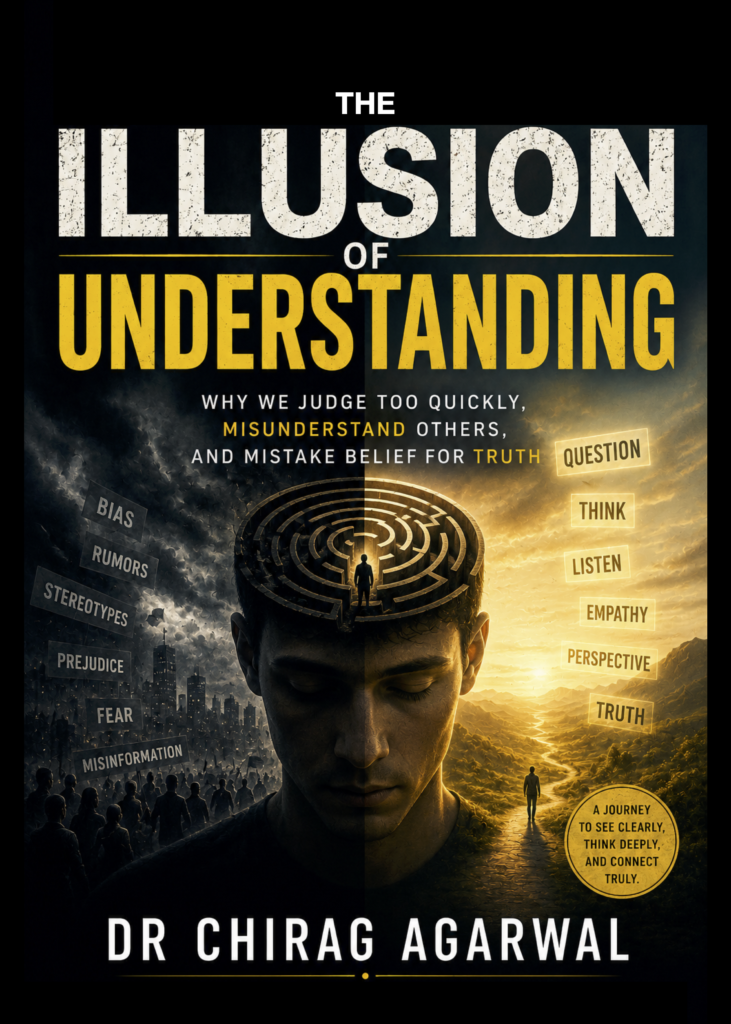
This idea is explored in greater depth in my upcoming book, The Illusion of Understanding, which examines how human beings form beliefs, misunderstand others, and learn to distinguish certainty from truth.