

We often believe that we make decisions by thinking carefully and choosing what appears to be the most reasonable option. Yet if we observe our own lives honestly, we quickly discover that our decisions are rarely the product of logic alone. The way we see a situation, what we feel about it, what we want from it, and what we are unwilling to lose can all influence the choice we eventually make.
This is one reason why intelligent people can sometimes make remarkably poor decisions. A person may possess knowledge, experience, education, and even good intentions, yet still choose something that causes unnecessary suffering. The problem is not always a lack of intelligence. Sometimes the difficulty lies in the forces that influence our judgment before the decision even reaches the stage of conscious reasoning.
The Rāmāyaṇa and the Mahābhārata offer a remarkably deep way of examining this aspect of human nature. Their characters repeatedly show us that decisions are shaped by several inner forces. Among the most important are perception, emotion, desire, attachment, and wisdom.
Understanding these five forces can help us understand not only the choices of the characters in the Itihāsas, but also many of the choices we make in our own lives.
Perception: We Act on What We Think We See
Every decision begins with perception.
Before we respond to a situation, we first form an understanding of what has happened. The difficulty is that our understanding may not always represent reality as it actually is. We do not simply observe events; we interpret them through our previous experiences, assumptions, fears, expectations, and beliefs.
The Rāmāyaṇa illustrates this through Kaikeyī.
For much of her life, Kaikeyī did not regard Rāma as a threat to Bharata. She loved him and accepted his virtues. Yet after Mantharā began speaking to her differently, Kaikeyī’s perception gradually changed. The circumstances surrounding Rāma’s coronation had not fundamentally changed, but the meaning Kaikeyī attached to those circumstances had. What had once appeared to be a joyful event began to appear to her as a danger to her son’s future.
This is an important distinction.
An event and our interpretation of that event are not always the same thing.
The same principle appears in ordinary life. A colleague may receive praise, and one person may see it as recognition of genuine effort while another sees it as favoritism. A friend may fail to return a phone call, and one person may assume they are busy while another immediately concludes that the friendship is no longer valued.
The external event may be identical. The perception is different.
And once perception changes, everything that follows can change with it.
This is why wise decision-making begins with a simple discipline: before reacting to what we think is happening, we should examine whether we have understood what is actually happening.
Emotion: When Feeling Becomes Judgment
Perception is followed by emotion.
We see something, interpret it, and then feel something about it. Sometimes that emotional response is appropriate and even valuable. Compassion can make us more humane. Love can strengthen relationships. Fear can protect us from danger. Anger can alert us that something important has been violated.
The problem begins when emotion stops informing judgment and starts replacing it.
At the beginning of the Bhagavad Gītā, Arjuna is not an ignorant or incapable man. He is an accomplished warrior who understands the situation before him. Yet when he sees his teachers, elders, relatives, and friends on the battlefield, his emotions overwhelm his clarity. His body trembles, his mouth becomes dry, and his bow slips from his hand. His difficulty is not that he possesses no knowledge. His emotional state has temporarily become stronger than his ability to act upon that knowledge.
Kṛṣṇa does not respond by telling Arjuna that emotions are inherently wrong. Instead, He helps him examine his situation with greater clarity.
That distinction matters even in modern life.
When someone insults us, anger may arise immediately. When someone we love disappoints us, hurt may influence our interpretation of their actions. When we are afraid of losing something, fear may make an otherwise manageable situation appear catastrophic.
The emotion may be real, but the conclusion we draw while experiencing that emotion may not necessarily be correct.
Wisdom therefore does not mean becoming emotionless. It means remaining capable of judgment even while experiencing emotion.
Desire: What We Want Can Influence What We Believe
Desire is another powerful influence on decision-making.
Desire itself is not necessarily harmful. Human beings need aspirations. The desire to learn can lead to knowledge. The desire to build something meaningful can lead to achievement. The desire to serve others can produce extraordinary acts of generosity.
The difficulty begins when desire becomes so strong that it starts determining what we consider to be true, reasonable, or right.
When we strongly want a particular outcome, we naturally become more willing to notice evidence that supports it and less willing to examine evidence that challenges it.
This is one of the deeper lessons visible in the Mahābhārata. Duryodhana’s desire for power was not merely a wish to possess more. Over time, that desire influenced how he interpreted the success of the Pāṇḍavas. Their prosperity increasingly appeared to him as something that had been taken from him, and his dissatisfaction strengthened his hostility toward them.
The same pattern can appear in much smaller ways in our own lives.
We may desperately want a particular job and therefore convince ourselves that every warning sign is insignificant. We may want a relationship to work and therefore ignore problems that we would immediately recognise if they belonged to someone else. We may want to prove that we were right and therefore become unwilling to consider information that suggests otherwise.
Desire can quietly change the question we ask.
Instead of asking, “What is right?”, we begin asking, “How can I get what I want?”
The two questions may lead to very different decisions.
Attachment: When We Cannot Let Go
Attachment is closely related to desire, but it is not identical to it.
Desire says, “I want this.”
Attachment says, “I cannot bear to lose this.”
That difference becomes important because attachment can remain powerful even after we recognise that a particular course of action is no longer beneficial.
The Mahābhārata gives us a profound example through Dhṛtarāṣṭra. He repeatedly received counsel regarding Duryodhana and the growing conflict with the Pāṇḍavas. Yet his attachment to his son made it difficult for him to act decisively according to what he knew to be right. His affection was genuine, but affection without sufficient discernment became a weakness in judgment.
This pattern is not limited to kings and kingdoms.
A parent may know that a child’s behaviour needs correction but avoid confronting it because discipline feels painful. A businessperson may recognise that a failing project should be abandoned but continue investing because too much time and money have already been spent. A person may recognise that a relationship has become unhealthy but remain because the thought of separation feels unbearable.
Attachment often tells us that letting go itself is the greatest loss.
Wisdom asks a different question: “Is holding on still serving what is right?”
That question is difficult precisely because attachment makes us emotionally invested in a particular answer.
Wisdom: The Ability to Step Back
If perception can distort what we see, emotion can cloud our judgment, desire can influence what we want, and attachment can make us unwilling to accept another outcome, what allows us to make a better decision?
The answer is wisdom.
Wisdom is not simply possessing more information. It is the ability to step back from our immediate impulses and examine them before allowing them to determine our actions.
This is why the Itihāsas distinguish, through their characters and their choices, between knowing something and being able to act wisely upon what one knows.
A person may know that anger is destructive and still act in anger. A person may know that attachment is clouding judgment and still refuse to let go. A person may understand the consequences of a decision and yet choose it because desire is stronger than discernment.
Wisdom begins when we become capable of observing these forces within ourselves.
Instead of saying, “I am angry, therefore I must respond,” we begin to think, “I am angry. What is this anger telling me, and should it determine my response?”
Instead of saying, “I want this, therefore I should pursue it,” we ask, “Why do I want this, and is pursuing it actually right?”
Instead of saying, “I cannot let this go,” we ask, “What is this attachment preventing me from seeing?”
This ability to pause between impulse and action is one of the foundations of wise decision-making.
Why This Matters
The most dangerous decisions are not always made suddenly.
Often, the process begins much earlier.
We perceive a situation in a particular way. That perception produces an emotional response. Our desires begin influencing our judgment. Our attachments make one outcome increasingly difficult to relinquish. If wisdom does not intervene, the final decision may appear to be rational to us even though it has been shaped by forces we never consciously examined.
The Bhagavad Gītā describes a related progression in its discussion of contemplation, attachment, desire, anger, delusion, and the eventual loss of discrimination.
The broader lesson is that a poor decision rarely begins at the moment we act.
It often begins at the moment we stop examining what is happening within us.
That is why the study of the Itihāsas is so valuable. They allow us to observe human decisions from the outside. We can see how perception changes, how emotions influence judgment, how desire develops, how attachment limits freedom, and how wisdom – or its absence – changes the outcome.
But the real purpose is not to analyse ancient characters from a safe distance.
It is to recognise the same processes within ourselves.
Before Your Next Important Decision
The next time you face an important decision, pause before asking only, “What should I do?”
Ask a few questions first.
What am I actually seeing?
What am I feeling?
What do I want to happen?
What am I afraid of losing?
And if I temporarily stepped away from my emotions, desires, and attachments, what would wisdom ask me to consider?
These questions do not guarantee that every decision will be easy. They do something more valuable: they make us aware of the forces influencing the decision.
And awareness creates the possibility of choice. Perhaps this is one of the deepest lessons hidden within the human stories of the Rāmāyaṇa and the Mahābhārata.
We do not become wise merely by learning what is right. We become wiser when we learn to recognise what within us is preventing us from doing what we already know is right.
Every decision begins long before the moment of action. It begins with the way we see. Then comes what we feel, what we want, and what we cannot let go of.
And somewhere within that process lies the opportunity to pause, examine, and choose with wisdom.
Want to Go Deeper?
The Rāmāyaṇa and Mahābhārata are not merely stories from the past. They are profound studies of human nature, Dharma, relationships, choices, and consequences.
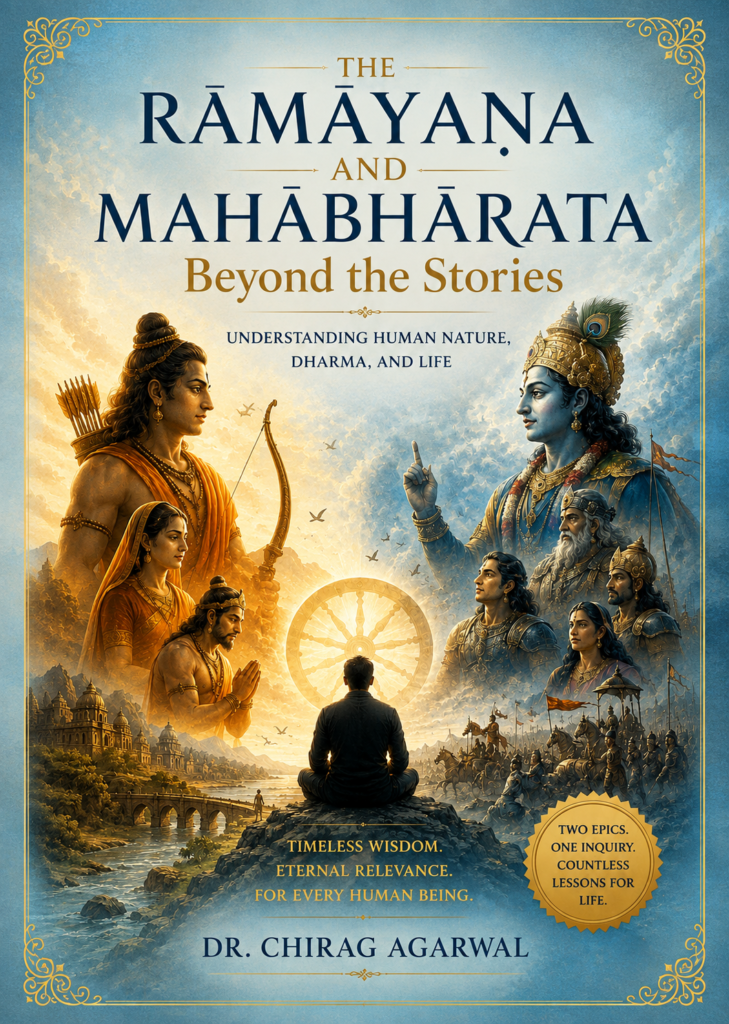
The Rāmāyaṇa and Mahābhārata: Beyond the Stories explores the wisdom hidden within these timeless narratives and asks a simple question:
What can their choices teach us about our own lives?
– By Dr. Chirag Agarwal