
“If there is only one Supreme Reality, why are there so many Gods?”
This is perhaps one of the most common questions asked about Sanātana Dharma.
To someone encountering the tradition for the first time, it can certainly appear confusing. One temple worships Śiva, another Viṣṇu, another Devī, another Gaṇeśa, another Sūrya, another Hanumān. Different Purāṇas even seem to declare different deities as supreme.
From the outside, it may seem that Sanātana Dharma teaches the existence of many unrelated Gods.
But is that really what the Śāstra teaches?
To answer this question, we must begin not with popular belief, but with the primary sources themselves.
The Foundation: Reality Is One
Primary Śāstric Reference
ऋग्वेद १.१६४.४६
एकं सद्विप्रा बहुधा वदन्ति।
Transliteration
ekaṁ sad viprā bahudhā vadanti
Meaning
Reality (Truth) is One; the wise describe It in many ways.
Essence
This is perhaps the most misunderstood verse in discussions on Sanātana Dharma. The Ṛgveda does not say there are many ultimate realities. It says Reality is One, while human beings speak of It through different names and perspectives.
The emphasis is on unity, not plurality.
The Upaniṣads Go Even Further
The Upaniṣads repeatedly describe the ultimate reality as Brahman – the limitless, eternal foundation of existence.
Primary Śāstric Reference
छान्दोग्य उपनिषद् ६.२.१
एकमेवाद्वितीयम्।
Transliteration
ekam evādvitīyam
Meaning
One alone, without a second.
Essence
If ultimate reality is “one without a second,” then the many names and forms encountered in worship cannot represent competing supreme beings.
They must instead be understood as different ways of approaching or expressing the same ultimate reality.
Then Why So Many Deities?
This is where many misunderstandings begin.
The Sanskrit word Deva does not simply mean “God” in the sense commonly understood in English.
The word comes from the root दिव् (div), meaning to shine, to illuminate, or to be radiant.
A Deva is therefore a luminous principle or divine manifestation.
Different deities emphasize different aspects of the Divine.
For example:
- Sarasvatī represents knowledge.
- Lakṣmī represents prosperity and harmony.
- Gaṇeśa symbolizes wisdom and the removal of obstacles.
- Sūrya manifests illumination and life.
- Śiva embodies dissolution, renunciation and transformation.
- Viṣṇu represents preservation, order and sustenance.
These are not necessarily competing gods ruling separate universes.
Rather, they express different dimensions through which the one Reality is understood and approached.
The Bhagavad Gītā Explains This Directly
Śrī Kṛṣṇa says:
Bhagavad Gītā ७.२१
यो यो यां यां तनुं भक्तः श्रद्धयार्चितुमिच्छति।
तस्य तस्याचलां श्रद्धां तामेव विदधाम्यहम्॥
Transliteration
yo yo yāṁ yāṁ tanuṁ bhaktaḥ śraddhayārcitum icchati
tasya tasyācalāṁ śraddhāṁ tām eva vidadhāmy aham
Meaning
Whatever form a devotee seeks to worship with faith, I make that faith steady.
Essence
The Gītā recognizes that human beings approach the Divine through different forms according to their temperament and understanding.
The emphasis is not on competition between forms, but on sincere devotion directed toward the Divine.
Different Minds Need Different Approaches
Human beings are not identical. Some are drawn toward compassion.
Others toward knowledge.
Others toward discipline.
Others toward motherhood.
Others toward strength.
Others toward silence.
Sanātana Dharma therefore provides many symbolic forms through which different temperaments may connect with the same truth.
Just as one teacher explains the same mathematical concept differently to different students, Śāstra presents one Reality through many symbols suited to different seekers.
Does This Mean All Gods Are Exactly the Same?
Not necessarily.
Different philosophical schools within Sanātana Dharma understand these relationships differently.
Advaita Vedānta, Viśiṣṭādvaita, Dvaita and various Bhakti traditions each articulate the relationship between Brahman and particular deities in distinct ways. This diversity is part of the tradition’s intellectual richness, not a contradiction. What they broadly share is engagement with the same śāstric foundations while offering different theological interpretations.
Then Why Do Different Purāṇas Declare Different Deities Supreme?
This naturally leads to another question.
If Reality is one, why does the Śiva Purāṇa glorify Śiva, the Viṣṇu Purāṇa glorify Viṣṇu, and the Devī Bhāgavata glorify Devī?
This is a deeper subject that deserves its own discussion.
Understanding that requires first understanding the purpose of the Purāṇas, the role of devotional literature, and the distinction between primary philosophical texts and later narrative traditions.
Conclusion
Perhaps the better question is not,
“Why are there so many Gods?”
but,
“Why does one Reality reveal itself through so many names, forms and symbols?”
Sanātana Dharma does not ask every seeker to approach the Divine in exactly the same way. It recognizes that human beings differ in temperament, understanding and disposition. The forms are many. The symbols are many. The approaches are many.
But the search remains one: the search for Truth.
References
- Ṛgveda 1.164.46 – ekaṁ sad viprā bahudhā vadanti
- Chāndogya Upaniṣad 6.2.1 – ekam evādvitīyam
- Bhagavad Gītā 7.21
This Is Just One Question.
The Lost Language of Dharma explores many of the questions that millions ask – but few examine through the lens of Śāstra.
Inside the book, you’ll discover:
✓ Is Dharma the same as religion?
✓ Why are there so many Gods in Sanātana Dharma?
✓ Why do different Purāṇas declare different deities supreme?
✓ What is an Avatāra?
✓ Why do television serials and popular retellings often differ from Śāstra?
✓ What is the difference between Śruti, Smṛti, Itihāsa, and Purāṇa?
✓ How should we read sacred narratives – literally, symbolically, psychologically, or spiritually?
✓ Why does Sanātana Dharma encourage inquiry alongside devotion?
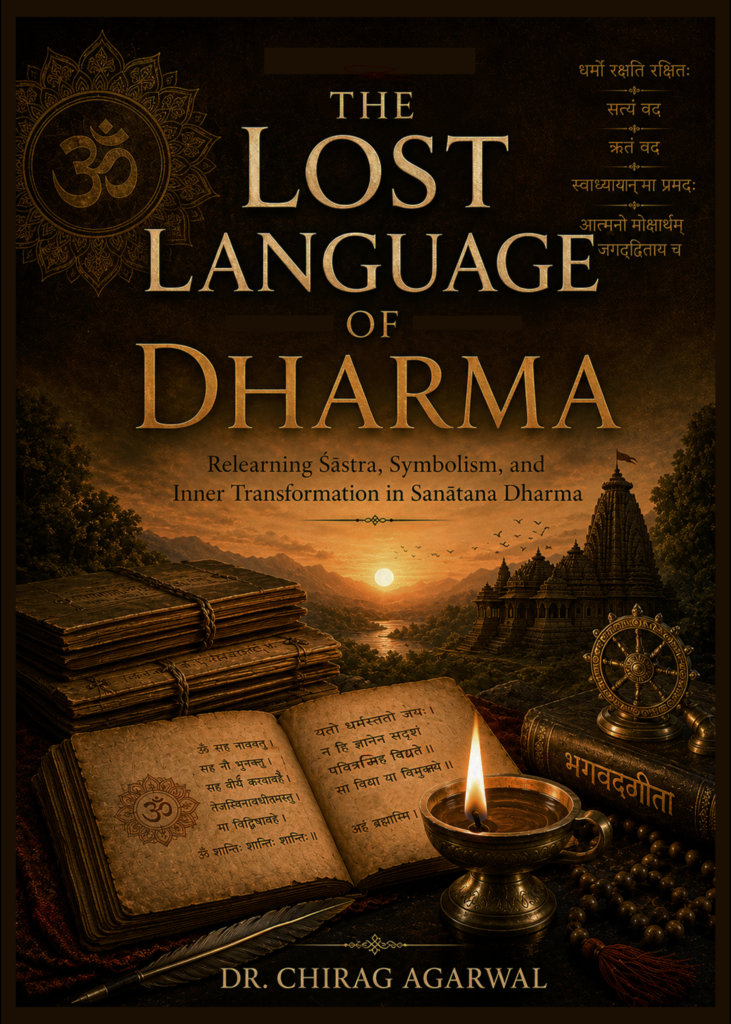
The Lost Language of Dharma is an invitation to move beyond inherited stories and rediscover the philosophical depth of Sanātana Dharma through its primary sources.